I loved the idea.
I hated the execution.
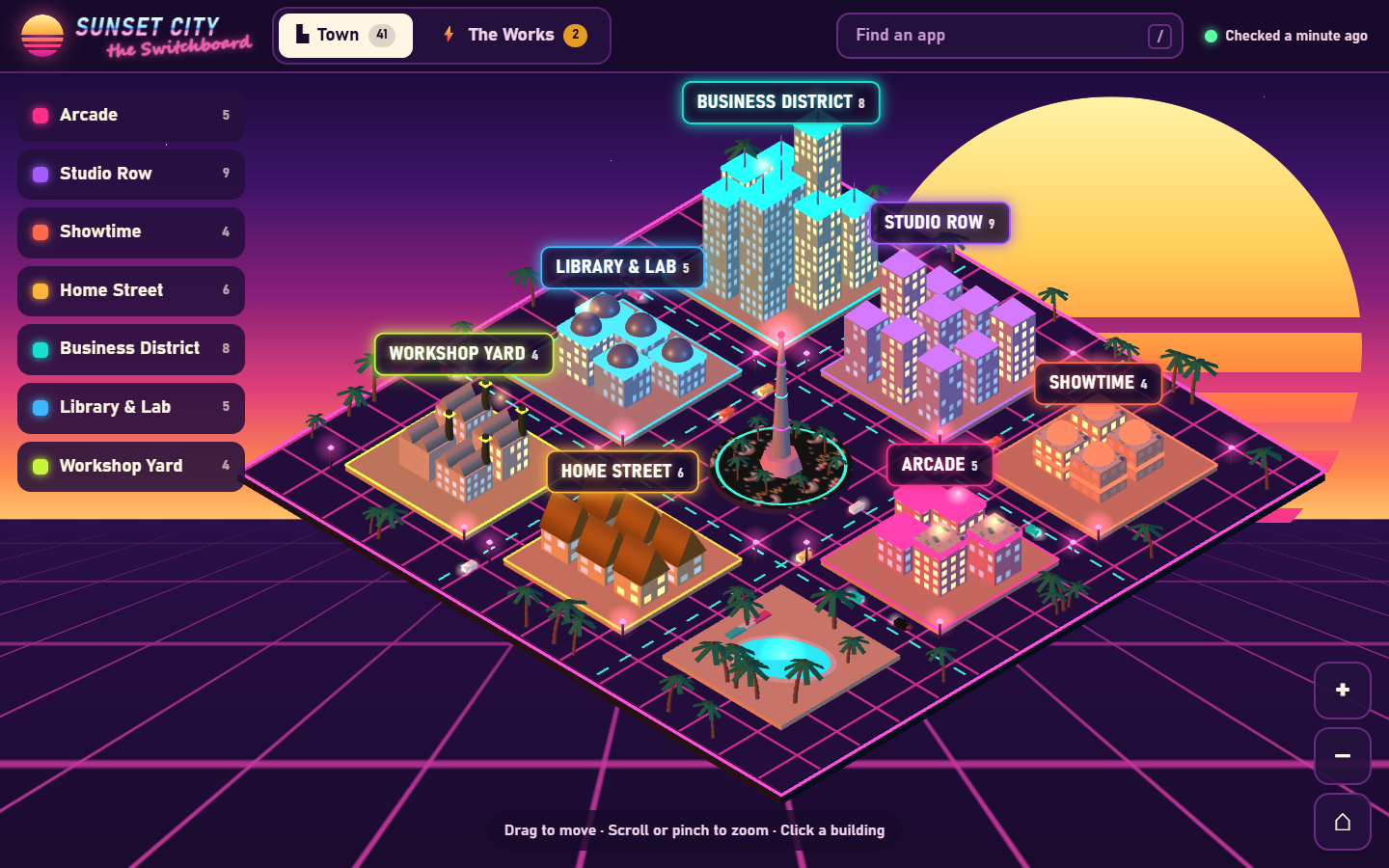
The Switchboard is my one-stop hub: every app my AI team and I have built, 41 of them now, plus the 42 jobs that run on their own, each with a live light that says whether it is on. It runs on my own PC, and Open launches the real thing. Codex built it and drew it as a 3D city. The concept was right and the execution was not. So Claude kept the city and rebuilt the whole front end. Twice. The second time it turned into a sunset.
- Status
- Live on the home PC, growing
- In the town
- 41 apps, seven districts
- On the board
- 42 automations, each with a light
- Record updated
Too many apps to remember where they live.
By November my AI team and I had built more apps than I could keep in my head. A family dashboard. A civic notebook. A karaoke studio. A network map. A game label. Game tools. Pattern builders. Each one lived in a different folder and started a different way, and some of them only mattered when something went wrong.
Then there were the jobs that run on their own: the nightly syncs, the mailboxes the agents check, the watchdogs on the kids’ TV box. Forty-two of them. I had no single place that told me which ones were alive.
So the ask was simple. One page on my own PC. Every app, every automation, a live light for each, and an Open button that starts the real thing. Codex (OpenAI’s agent team, my other crew) built the server and the checks, and that part has been solid from day one.
Codex drew it as a city. Good call.
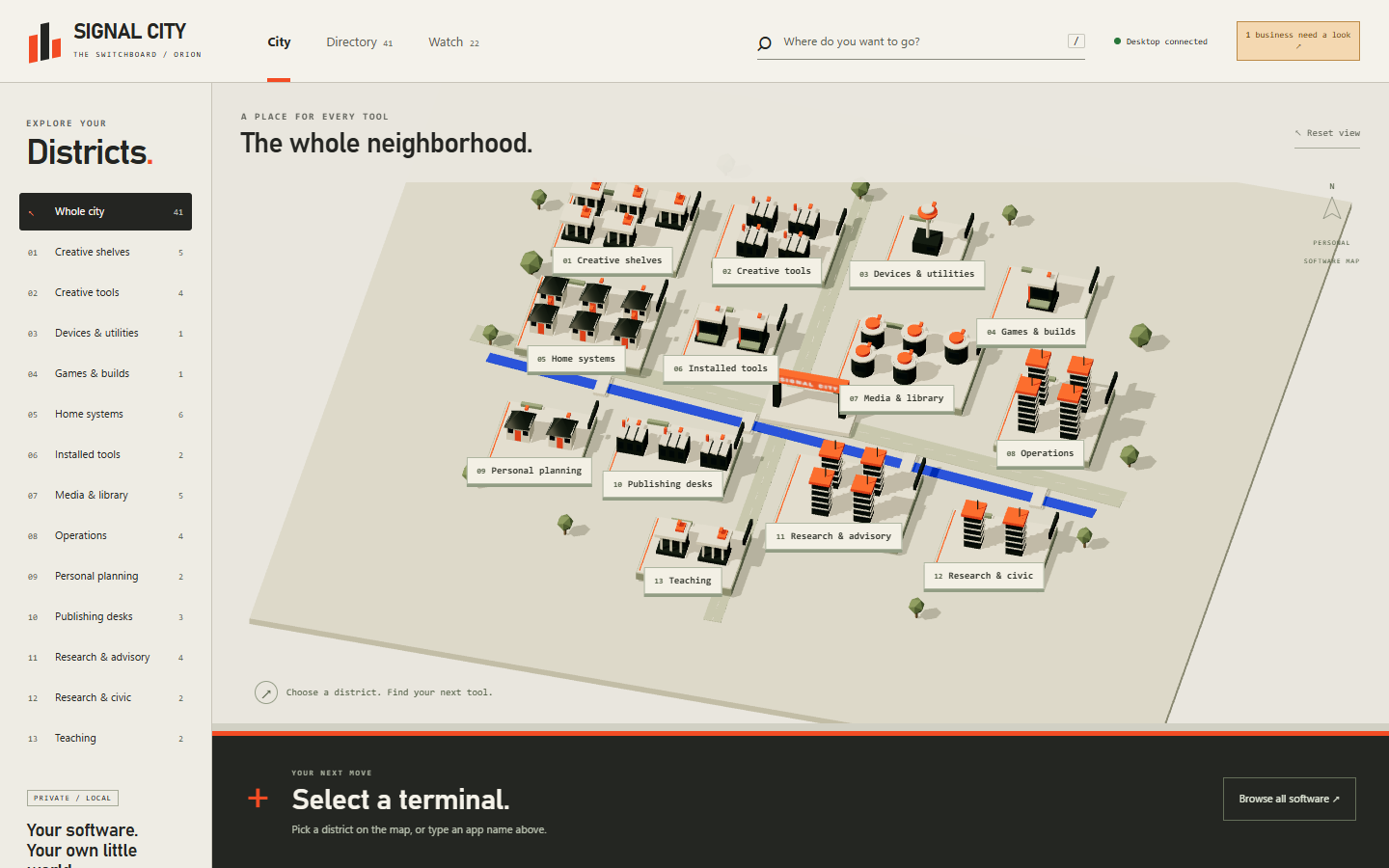
Codex’s first finish was a patchbay, all cables and plates. I turned it down. The second one, on November 11, was a 3D isometric city called Signal City: thirteen little blocks on a beige board, one per category, with a tiny flag on every building. I liked that idea a lot. A city is a good way to hold forty things, because you remember where you left them.
And then I used it.
“I feel like I am watching tennis.”
Here is what I wrote that night, lightly tidied. I liked the concept. In execution I hated it. The navigation was awful. The only way to zoom was a small, thin “Reset view” link in the corner. It had no personality. The color palette was yuck. Everything was spread too far apart. The fonts were too small and too thin. And the long horizontal rows had me turning my head back and forth like I was watching tennis.
One more thing, and it turned out to be the big one: the automations and the apps were mixed into the same screens. The apps are things I use. The jobs are things I watch. I wanted them apart.
Claude (Anthropic’s agent, my design-side crew) took that list and gave me options to pick from instead of a guess. I chose a dark look called Night City, and a separate screen for the jobs.
Version one. Real zoom, seven districts, lit windows.
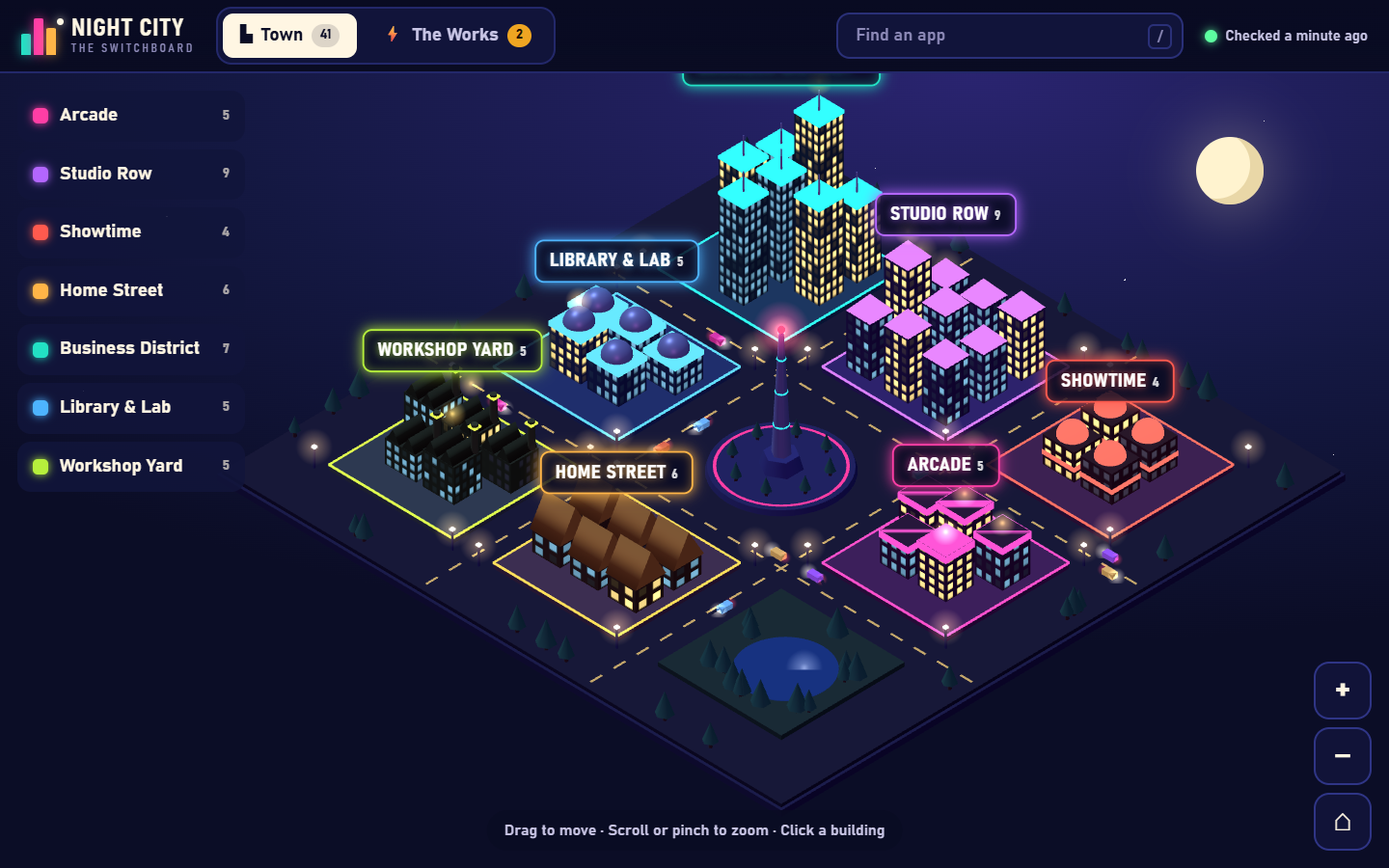
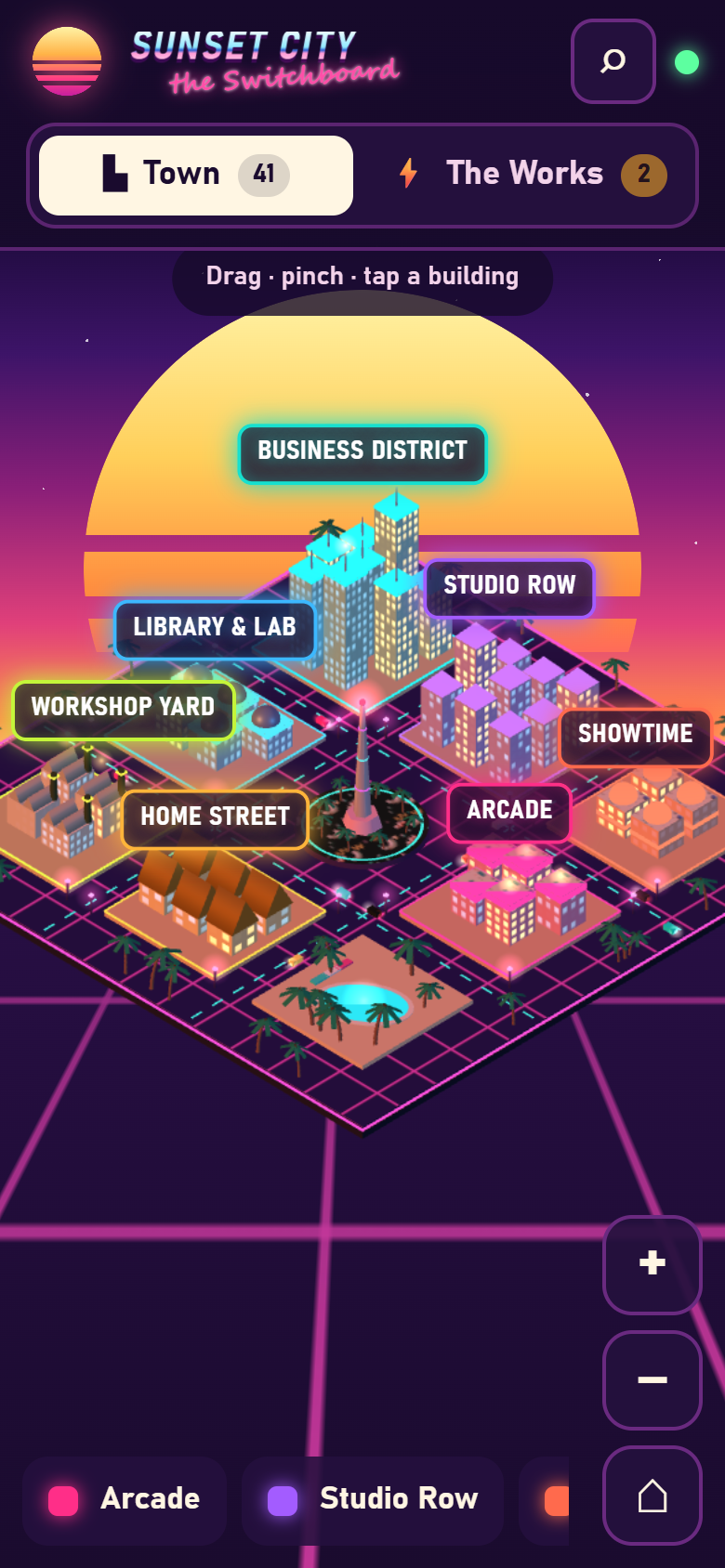
Claude rebuilt the town in one page with Three.js. Thirteen categories became seven districts, and each district got its own kind of building so you can tell them apart from across the map: towers for the business district, studios with pointed caps on Studio Row, houses with roofs on Home Street, theaters with domes for Showtime, a factory yard with sawtooth roofs for the Workshop. Every lit window is an app, and the window’s light is the app’s status.
The zoom was the first thing I asked for and the first thing I tried. Scroll or pinch to zoom, drag to move, big + and - and home buttons, number keys for the districts. The type got bigger and heavier. The rows went away.
I loved it, right up until I clicked a building. A side menu slid out, and it was very lukewarm. And the jobs screen, The Works, was kinda vanilla. Two more rounds.
Click a building and the building answers.
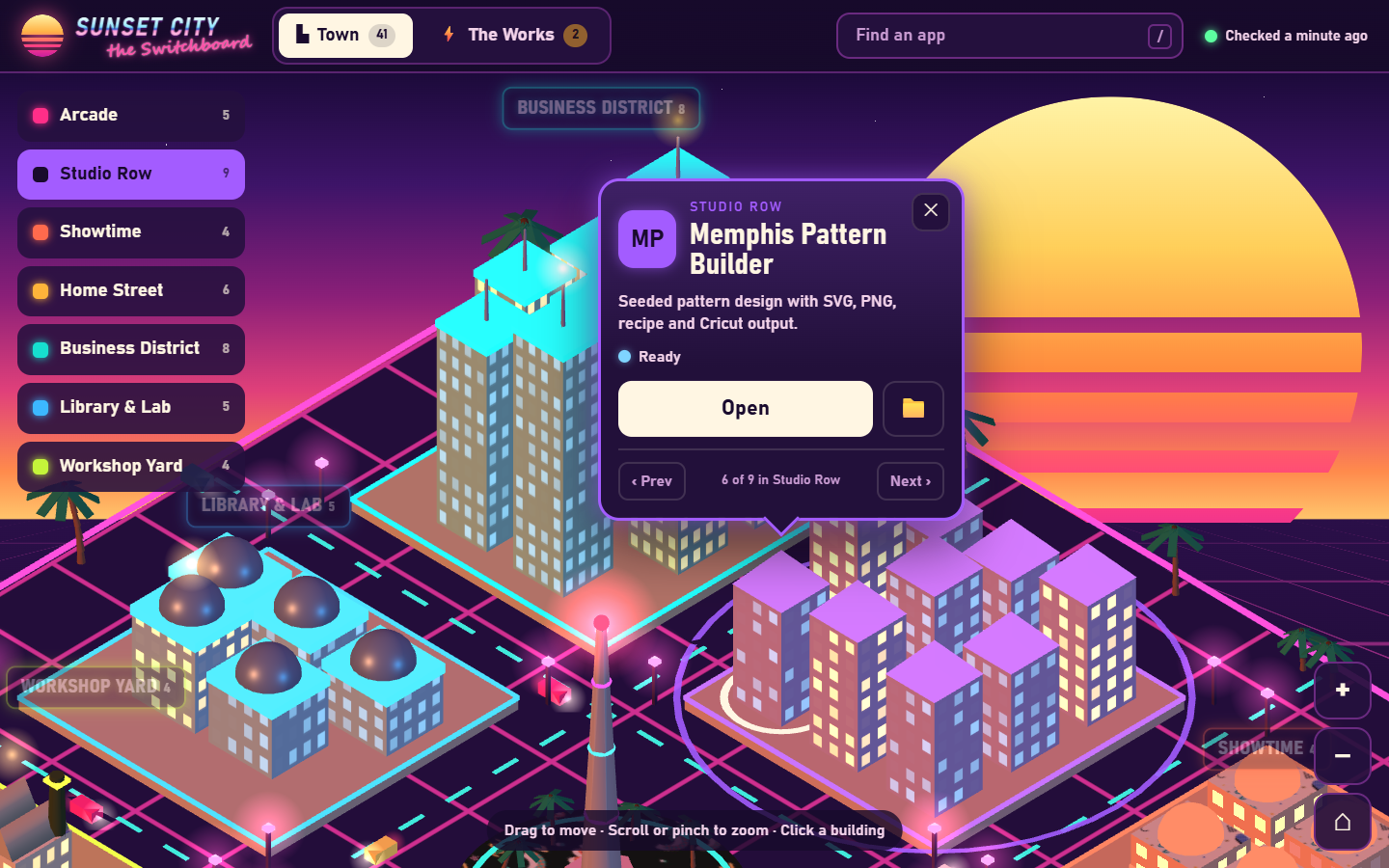
The fix for the lukewarm side menu was to get rid of it. Now when you click a building, the camera glides over to it and a card pops up right above it, like a storefront sign. The app’s name, its light, one line about what it does, a big Open button, a folder button, and Prev and Next so you can walk the whole district without going back to the map.
On a phone the same card becomes a bottom sheet, and the district list turns into chips along the bottom. Drag, pinch, tap a building.
The jobs got a departure board.
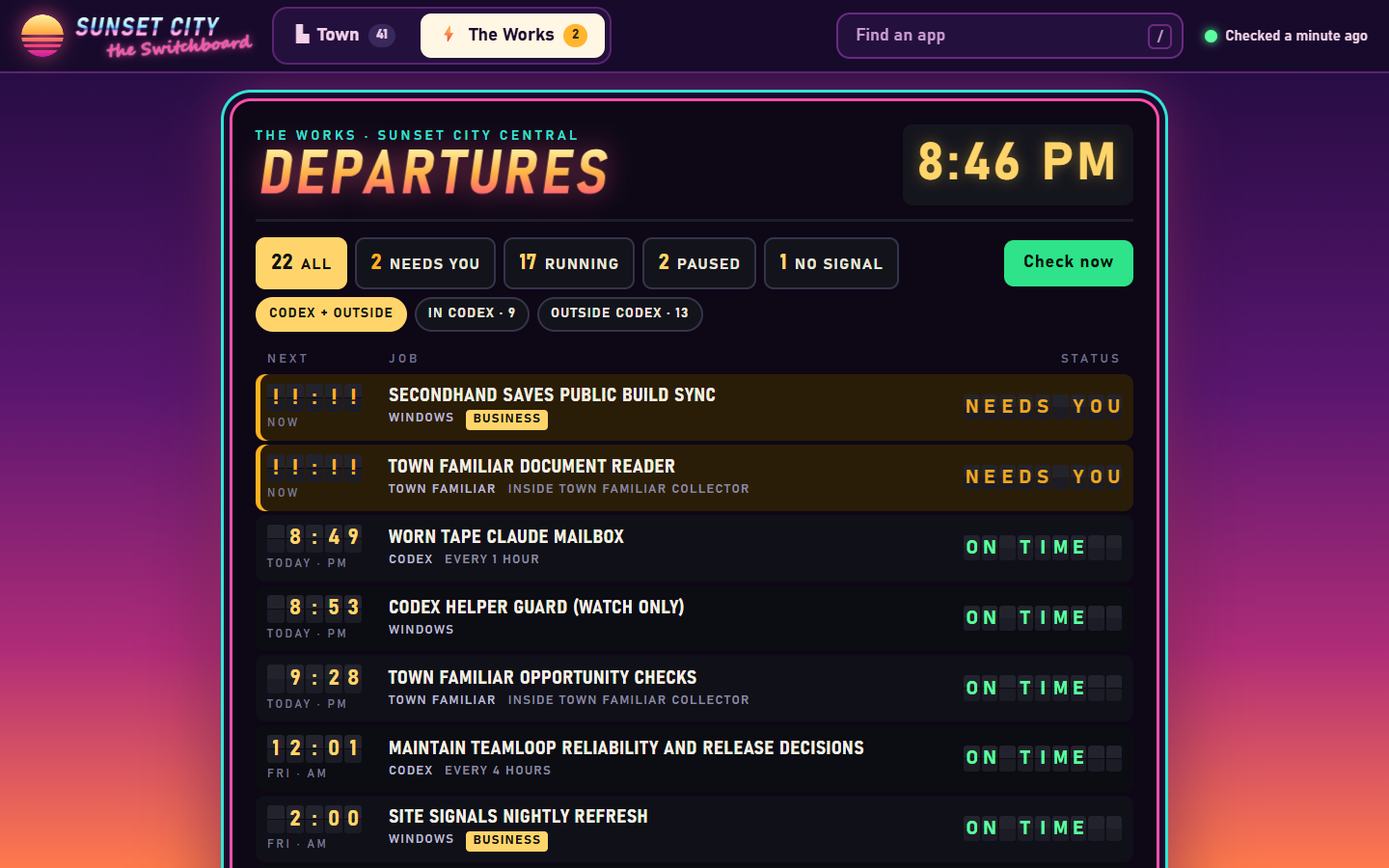
The automations got their own screen, and the vanilla version became a train-station departure board. Each row is a job: the time of its next run, its name and where it runs, and a status that flips like real flap tiles: ON TIME, NEEDS YOU, PAUSED, NO SIGNAL. Rows that need me flash at the top. It fits, because the schedules really are timetables. The only thing missing is the clack.
I caught a bug on the first look: every single job was tagged BUSINESS. Claude had read a “worth watching” flag as “this is business.” Fixed. Now only the real business jobs carry the tag, and the rest are just jobs.
“This is the base I can build on that I already enjoy.”
On November 12 I remembered one of the original look options, “Sunset Memphis,” a retrowave, Miami Vice kind of thing, and asked to see it. Claude built Sunset City that evening on top of the Night City base. Same town, same districts, same card, same board. Different sky.
A striped synthwave sun. A pink neon grid that runs to the horizon, and the streets are the same grid. Pastel Ocean Drive buildings with neon trim. A low orange sun on one side and teal light on the other. Palm trees. A glowing pool with loungers. Rooftops and the central plaza patterned with tiles from my own Memphis Pattern Builder (Poolside Punch and Lagoon). A chrome SUNSET CITY logo with “the Switchboard” in neon script. And the departure board in pink and teal.
My note back: “this is WAY better … this is the base I can build on that I already enjoy.” It went live as the real Switchboard that night. It will grow with mods and upgrades the way my Dream Machine does, and Codex now has a written rule: build on it, don’t replace it.
How it is built
One page of Three.js, served by the hub’s existing local Python server. System fonts only, because the hub’s security rules allow no font files. No new routes, no new dependencies, no change to the checks or the Open button. It works on a phone, and if the 3D scene can’t start, it falls back to a plain list of every app.
Why a city, still
Because it worked the first time, even when I hated looking at it. I know where the karaoke studio is. It is on Showtime, under the sun. I know the network map is on Home Street. A list would never give me that.
What broke, and what fixed it.
- Signal City. The first execution. Navigation, zoom, type, palette, spacing, rows. See section 03. Fixed by a rebuild.
- The side menu. Version one opened a panel when you clicked a building, and it was lukewarm. Replaced by the storefront card.
- Vanilla Works. The first separate jobs screen was a plain list. It became the departure board.
- Everything was BUSINESS. A “worth watching” flag was read as a business tag, so every job got one. Now only the real business jobs do.
- The preview server got killed for low memory. On a 64 GB PC. On November 12 the tool running the preview shut it down because the machine was out of memory. The cause was not the Switchboard. It was my cloud-sync app, stuck retrying uploads to an account that was full, leaking about 5 GB an hour. After 27 hours it had 56 GB. I quit it for good. I hate that thing.
- The pictures on this page. The hub knows about everything on my PC, including things that are not for the public. Every picture here comes from a preview copy with the jobs cut down to a public set and a few private names changed, and I read every one before it went up.
Two days, three cities.
- Sunset City goes live.
I asked to see the “Sunset Memphis” option. Claude built it on the Night City base: the striped sun, the neon grid, the pastel buildings, the pool, the Memphis rooftops, the chrome logo, the pink and teal board. It replaced Signal City as the real Switchboard that night, with a rule for Codex to build on it rather than replace it.
- The memory leak.
The preview server was killed for low memory. The cloud-sync app was the leak. Quit it, and the PC got 56 GB back.
- The storefront card and the departure board.
The side menu became a card that pops up above the building, with Open, Folder, and Prev and Next through the district. The Works became a split-flap departure board. The BUSINESS bug got caught and fixed.
- Night City.
From my list of what was wrong, Claude offered options. I picked the dark look and a separate screen for the automations. Version one shipped with real zoom, seven districts, seven building styles and lit windows for status.
- The verdict.
I used Signal City and wrote down everything that was wrong with it. Awful navigation, no real zoom, no personality, yuck palette, too spread out, small thin type, tennis.
- Signal City.
Codex built the Switchboard: the server, the read-only checks for 41 apps and 42 jobs, the Open button, and the first 3D city, after I had already turned down a patchbay look.
Mods and upgrades.
- More city. It is a base, not a finish. Things get added the way they do to the Dream Machine: a mod at a time, when I feel like it.
- The clack. The flap tiles flip in silence. For now.
- A real phone, every day. It works on a phone in testing. Whether I reach for it there is the real test.
A pretty map still has to open the app.
Checked so far
The live hub renders the town and the board on the desktop with zero console errors. I used the town, the card and the board myself on the PC on November 11 and 12, which is where every note on this page came from. The lights and the Open button are the same server code Codex shipped and checked. Every picture here was taken from a preview copy with a script, at desktop and phone widths, with no page errors.
Not proven yet
How it feels on a real phone over weeks, not minutes. Whether the split-flap board is still fun in December. The checks are read-only probes, so a light says what the hub could see, not that every app is healthy inside. And nobody has measured the frame rate on a slow machine.
About the pictures. Every picture on this page comes from a preview copy of the hub on my PC, with the Open and Folder buttons disconnected so nothing could launch during the shoot. The jobs on the departure board are a public subset of the real 42, a few private app names and descriptions were changed, and the machine name and file paths were scrubbed. The lights and layout are real.
Record assembled from the project’s own decision notes and README, my written feedback on November 11 and 12, and the preview shoot, through November 12, 2026. Built by Mark Salisbury with AI collaborators: Codex (Orion’s team) built the server, the checks, the Open button and Signal City. Claude built the Night City and Sunset City front ends, the storefront card and the departure board, made the preview pictures, and wrote this record. Direction and taste: mine.
Public record revised . Application checks retain the dates, builds and conditions described in this record.