A little more order.
A lot more personality.
BuryBoard is the family dashboard I built with AI agents: a shared calendar, weather, things to do, and a strawberry companion called Berry. It runs on a small computer and a spare screen. Getting it to feel like something that belongs in our home took considerably more work than getting a calendar onto a TV.
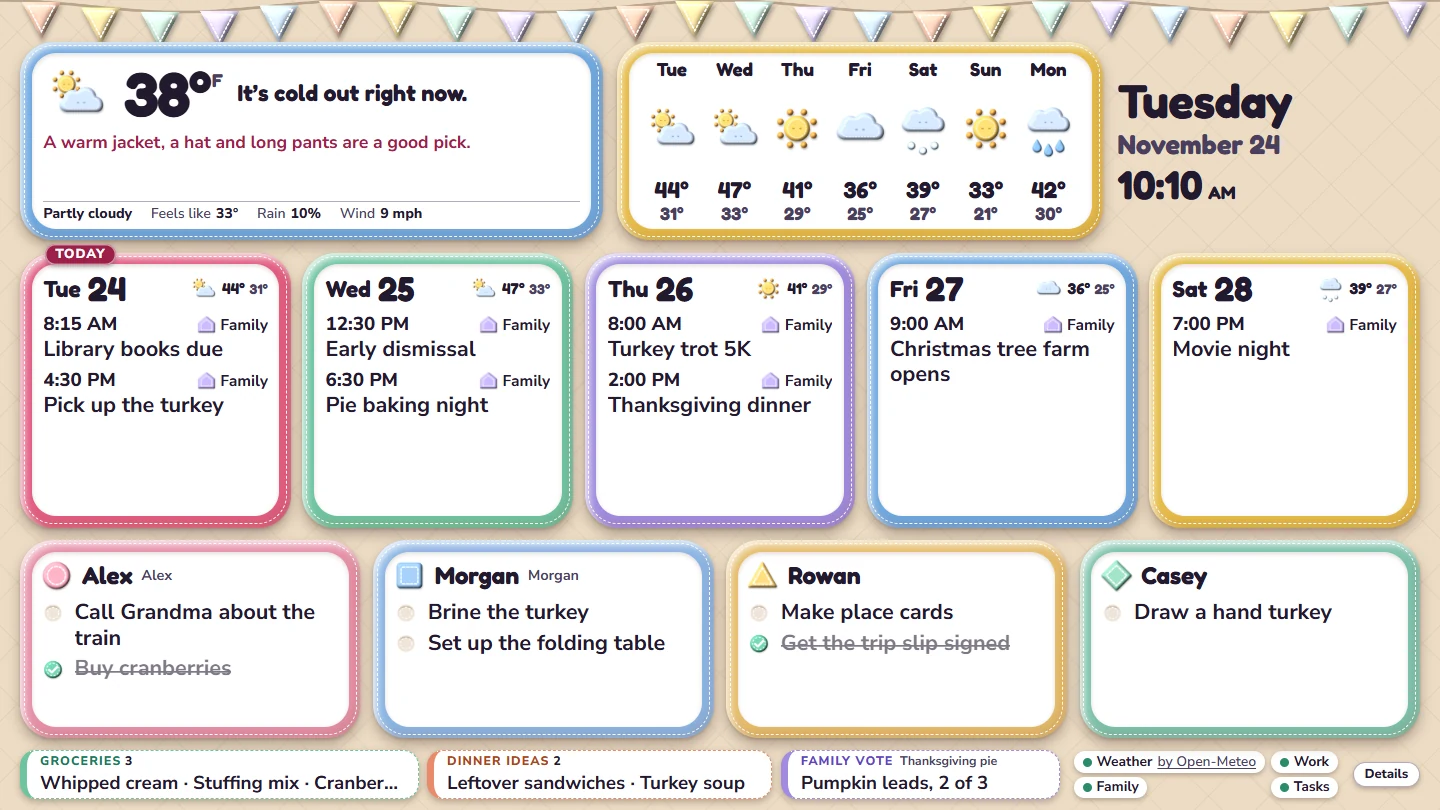
A household screen has to survive a Tuesday.
The practical job is simple: put the next few days where everybody can see them. Calendars, weather, each person’s list, grocery requests and dinner ideas should be available without someone opening an app and translating it for the rest of the house.
The board is a display. Adult controls live on a phone-friendly page. Berry lives on a repurposed Pixel and gives children a more approachable way to interact with the same household information. A completed task or confirmed request should show up on the board because both screens use the same state.
The project became a useful test of what building with AI actually involves. Art direction, interaction design, calendar handling, speech, data boundaries, recovery, browser testing and deployment all had to work together. A nice screenshot was one part of the job.
We did not stop at the first pretty calendar.
The exploration started wide: catalogs, small visual studies, then complete board treatments. Those were experiments, not dozens of finished products. By October 6, five directions were worth putting in front of the family. Each had to solve the same calendar-and-lists problem with a different visual language.
That last part matters. A theme needs to hold a crowded day, long lists and readable weather. The decorative layer has to make room for the information.
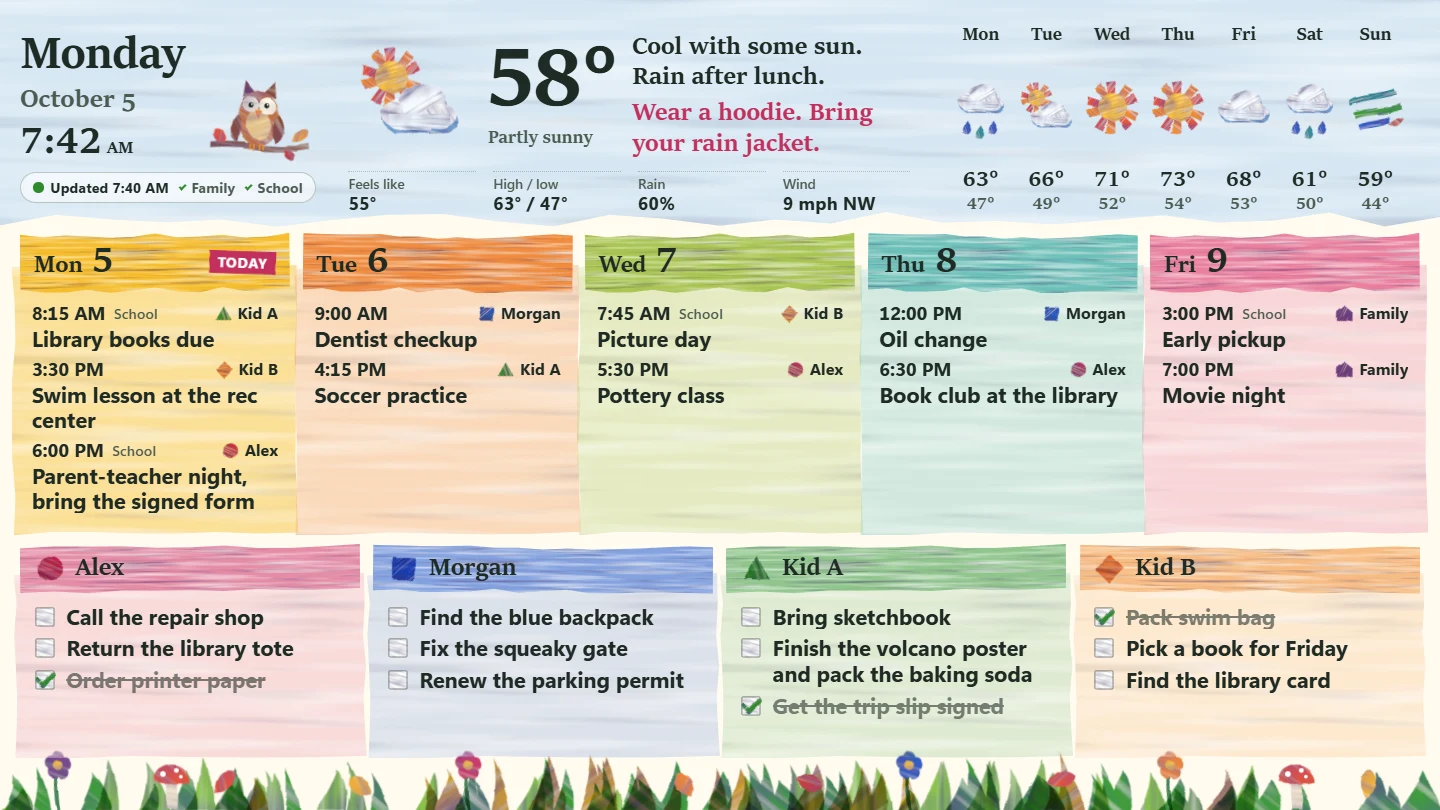
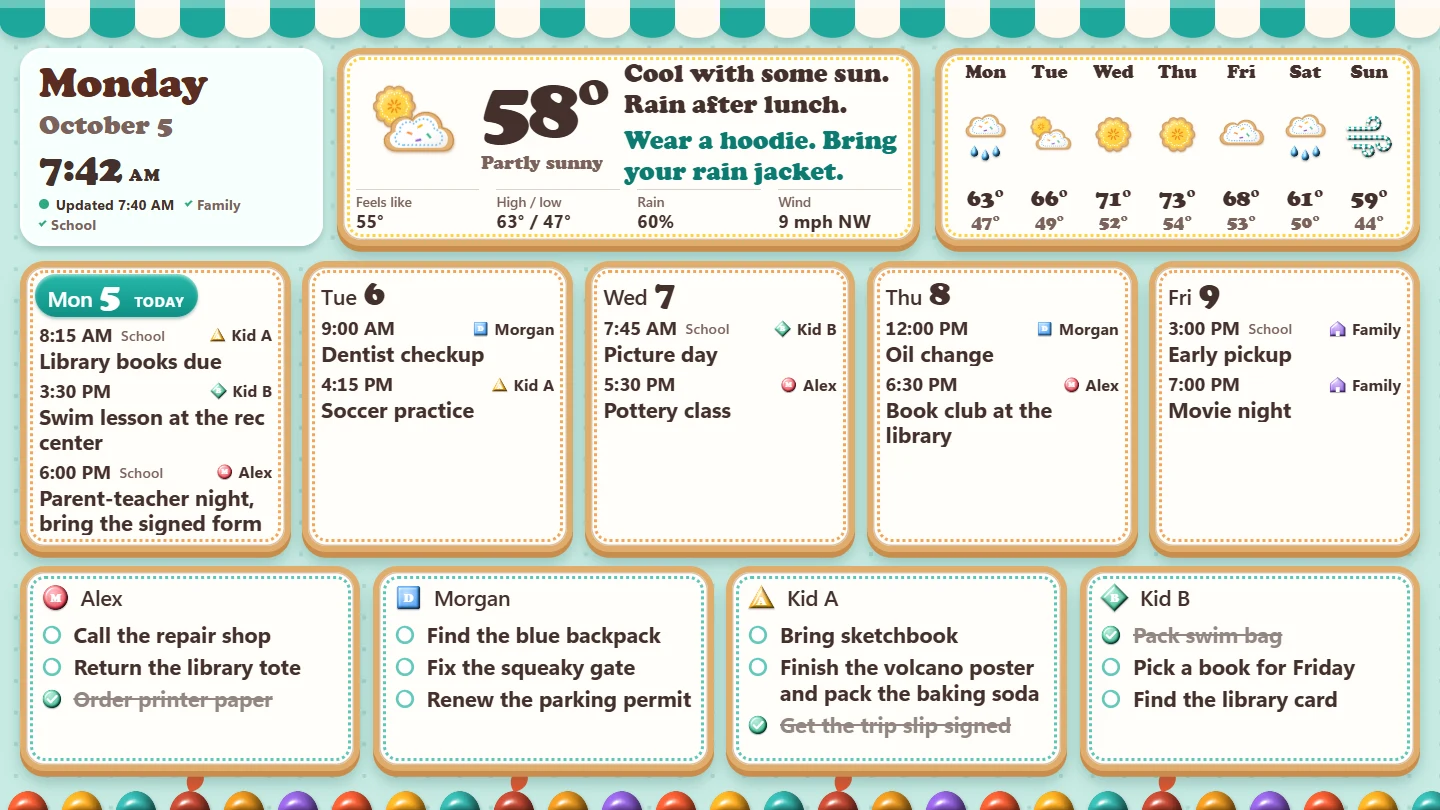
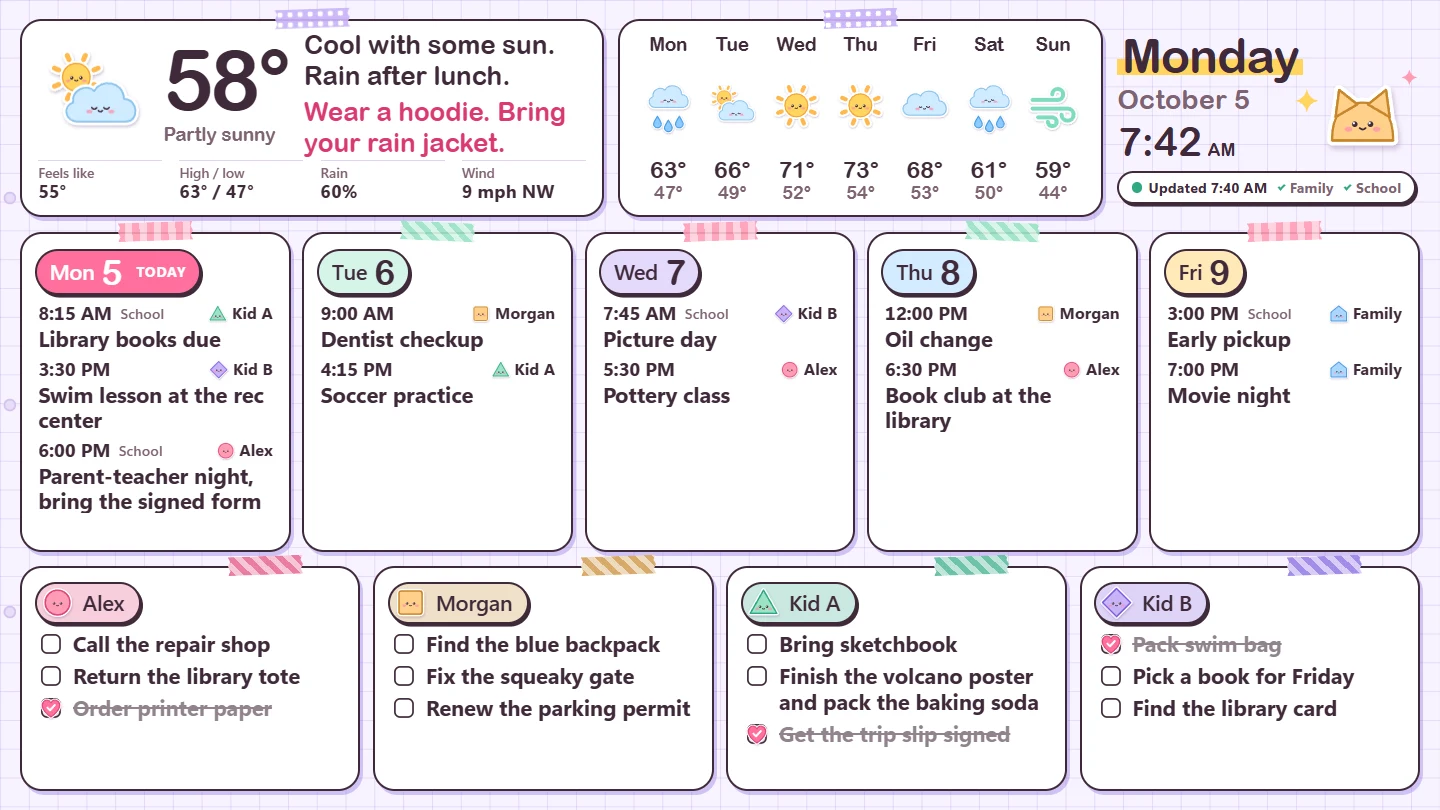
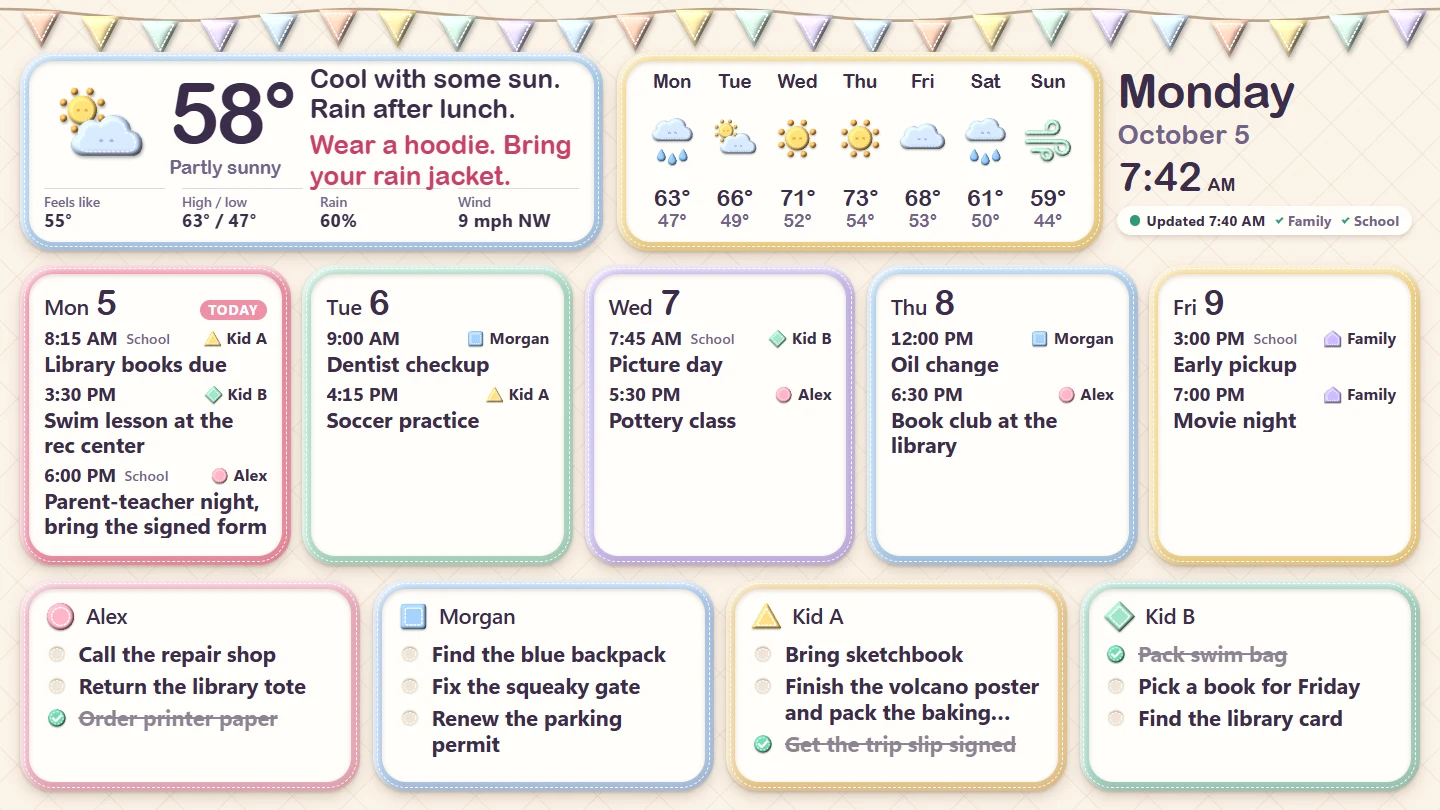
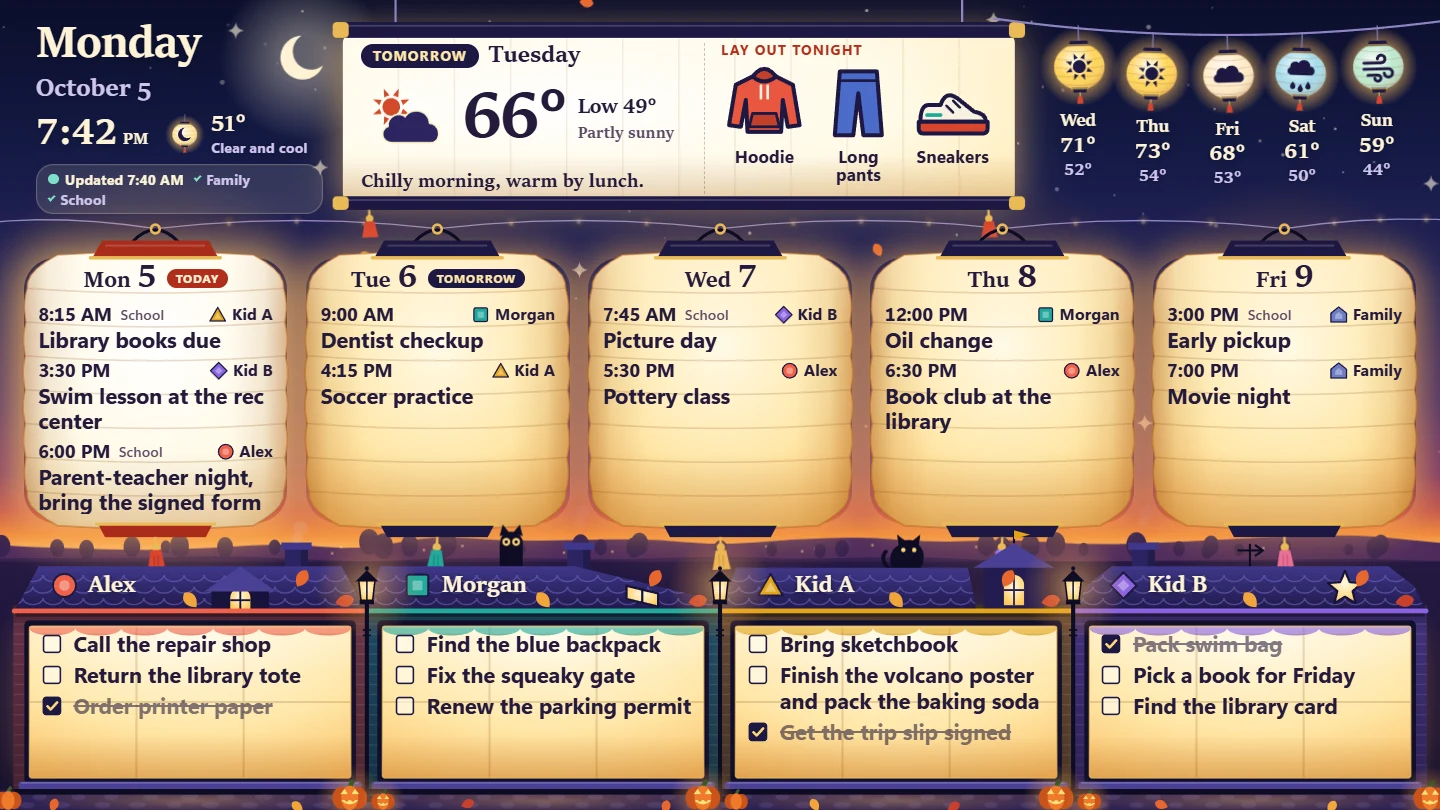
Two moods, one board.
Pillow Fort won the daytime vote. Lantern Lane was chosen separately for nighttime. We kept both because they fit different moments in the house.
The chosen typography follows that split: Fredoka for daytime headings, Literata for the night board and Nunito Sans for the shared body text. Person colors and the information hierarchy stay recognizable when the scene changes.
The public gallery preserves the original alternatives. They were real choices along the way, rather than themes invented afterward to make a portfolio look busy.
Lantern Lane became a little street.
The first night board went live on October 8. The later street pass tied the foreground, lamps and curb to the houses instead of leaving them as fixed decorations. Roof proportions stay intact as lists grow. Lamps and pumpkins flicker; a cat and an owl wear weather-appropriate gear.
The day-to-night transition also grew up. A fixed evening/morning schedule gave way to sunrise and sunset, with an offline solar calculation available when upstream data is missing. A fixed schedule is still an option. The result follows the season instead of insisting the sun go down at the same time all year.
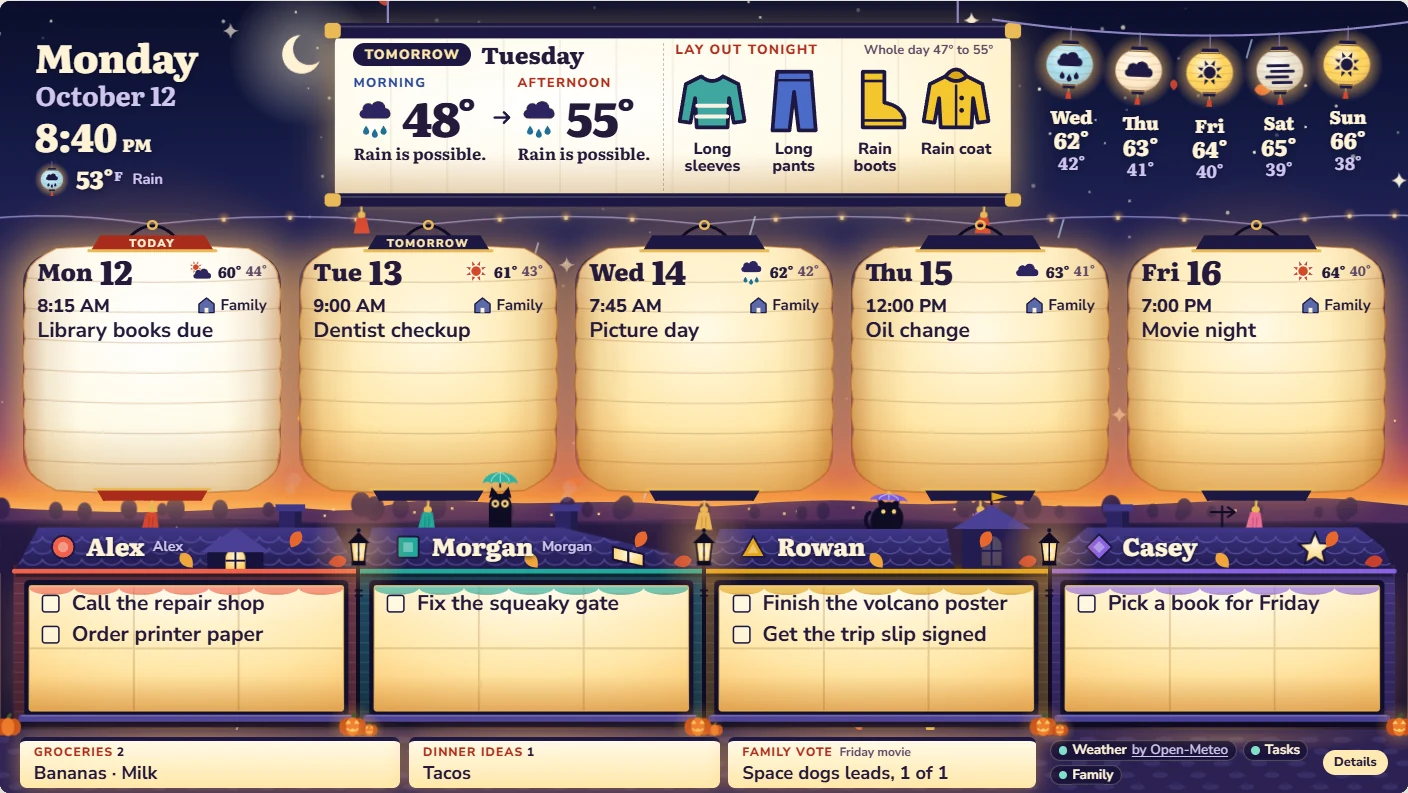
One small edge case says a lot about the project: clothing guidance used to jump ahead at midnight. The updated board holds the current day before noon and moves to tomorrow after noon. Waking up early should not make the board skip the day you are about to have.
October got four costumes.
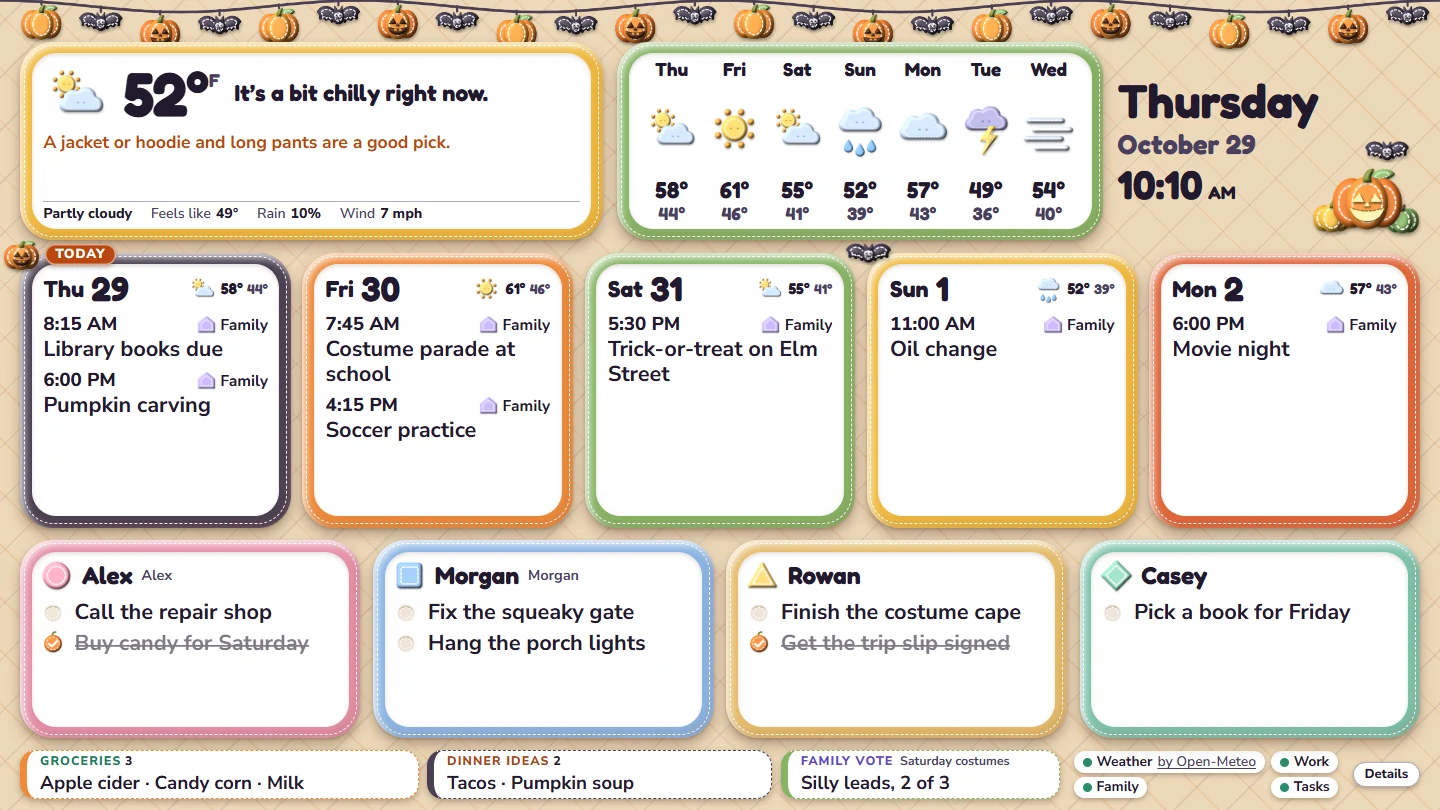
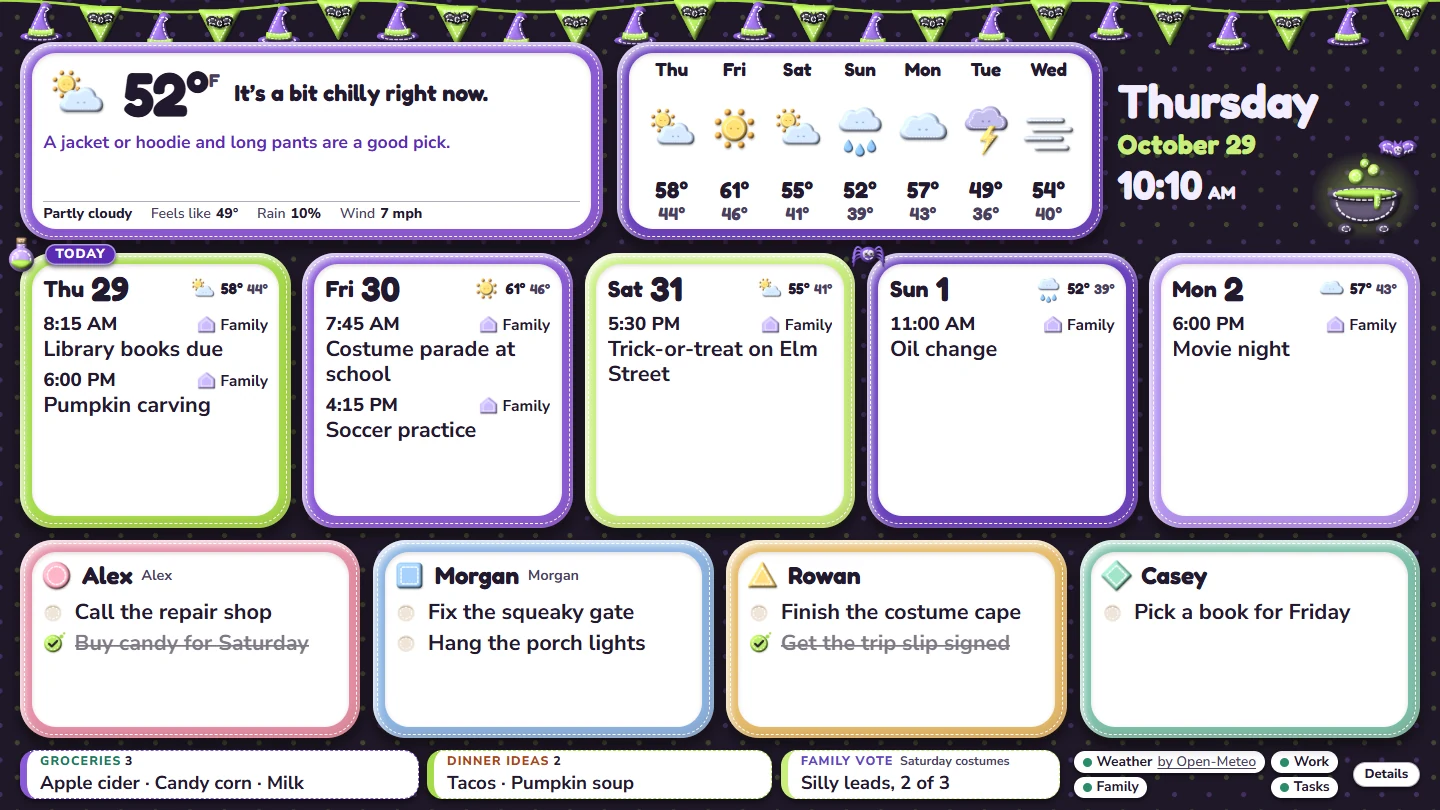
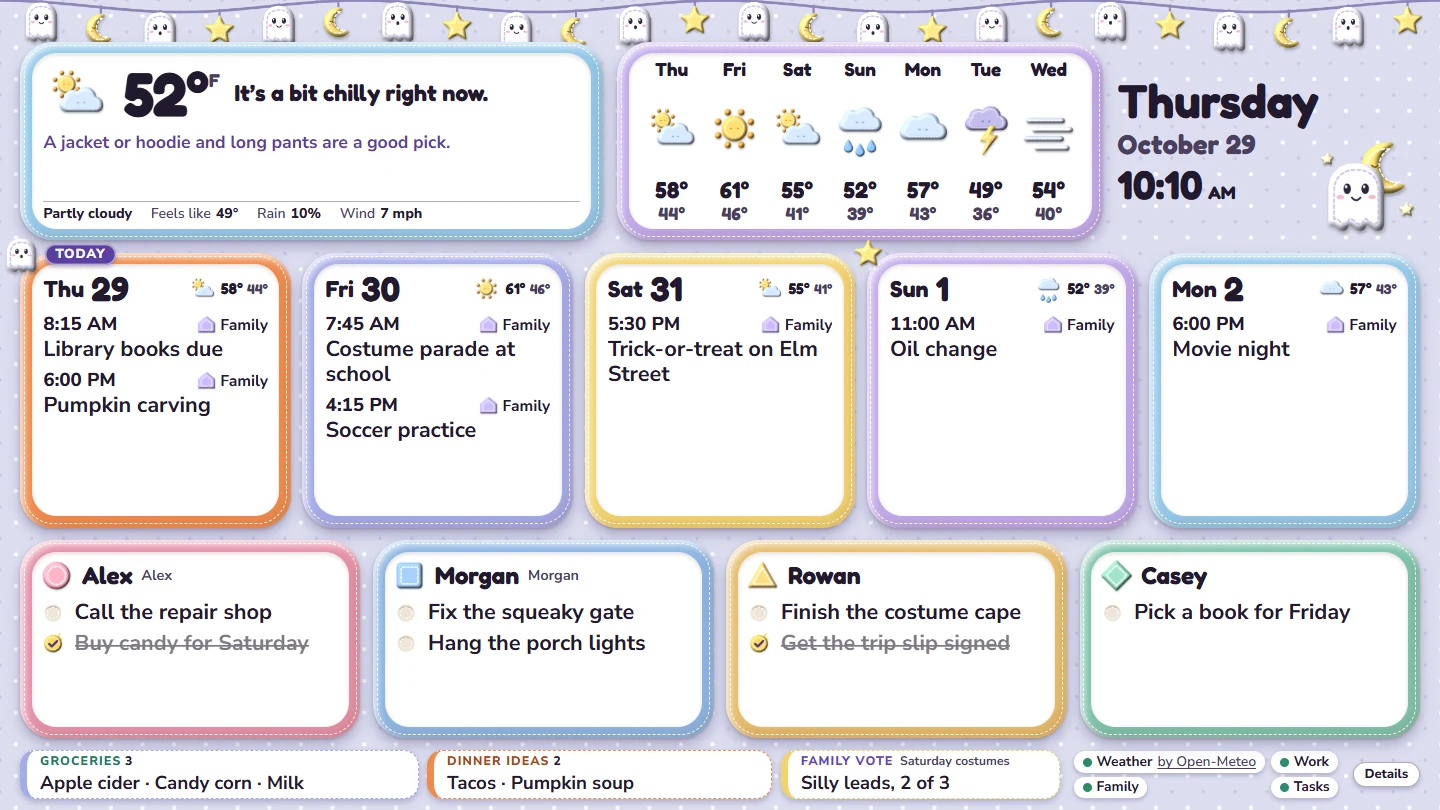
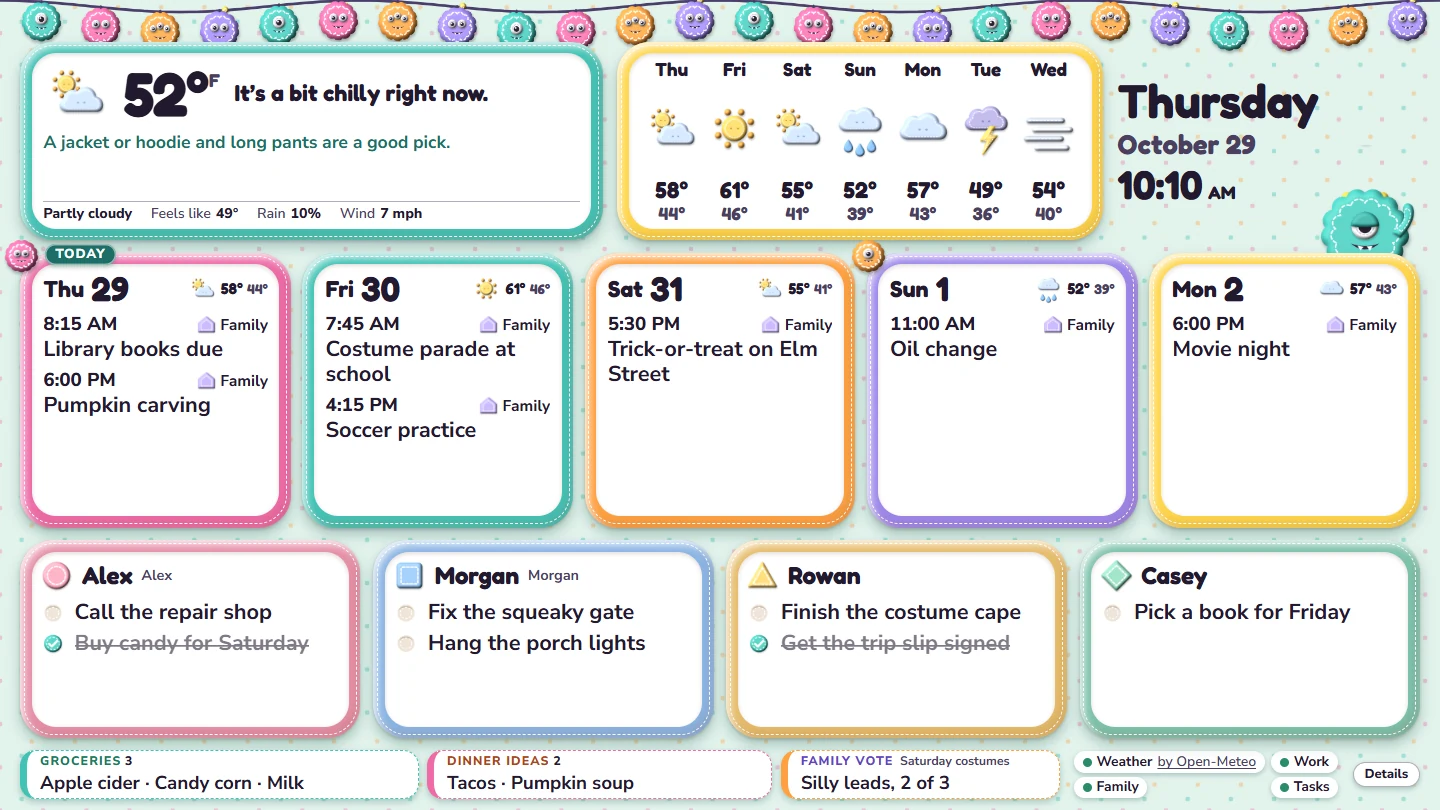
The holiday work uses a slot inside the daytime Pillow Fort system. The calendar, lists, fonts and person colors retain their jobs while the art changes around them. Lantern Lane keeps its nighttime identity.
The selected October pack went live on October 12. It rotates daily through four styles, anchored so Halloween itself always gets Pumpkin Patch. Candy Corn was considered and explicitly left out.
Movement had to earn its space.
Weather art acts out the condition it represents. Motion has Off, Subtle and Full settings; reduced-motion preferences stop animation. The day cards remain still. Checks freeze the animation at different moments to make sure decoration does not wander over words.
Five ideas became four November styles.
The Thanksgiving exploration began with Gobble Gobble, Pie Shop, Maple Walk, Farm Stand and Flannel & Cocoa. The turkey and pie ideas worked better together. Gobble & Pie kept the wheat plaid and combined the characters; Pie Shop’s red kitchen check did not carry into the final pack.
The November rotation was deployed on October 20, ready for the next month. Its anchor follows the fourth Thursday of November, so Thanksgiving gets Gobble & Pie every year. November 1, 2026 maps to Flannel & Cocoa. December 1 returns to the ordinary board.
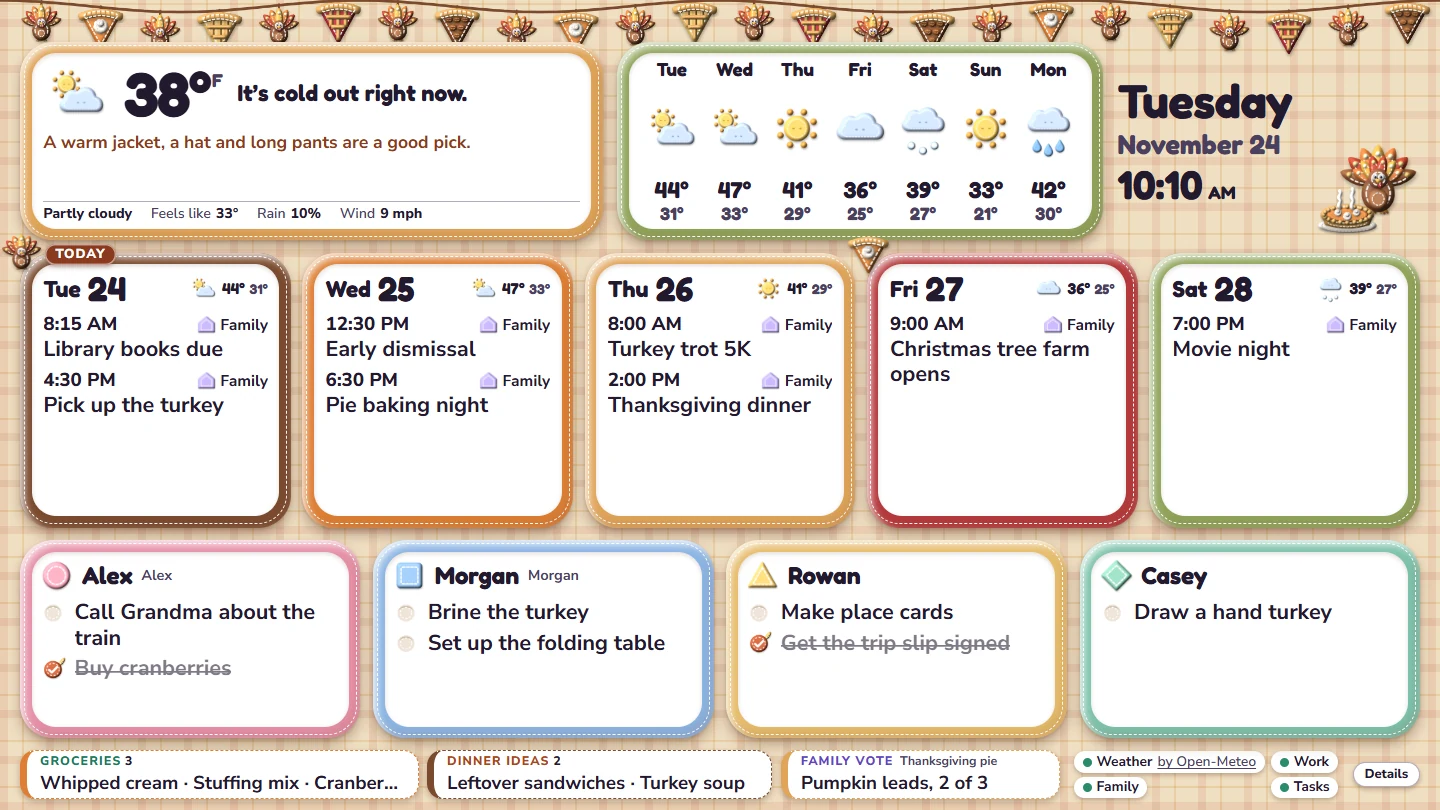
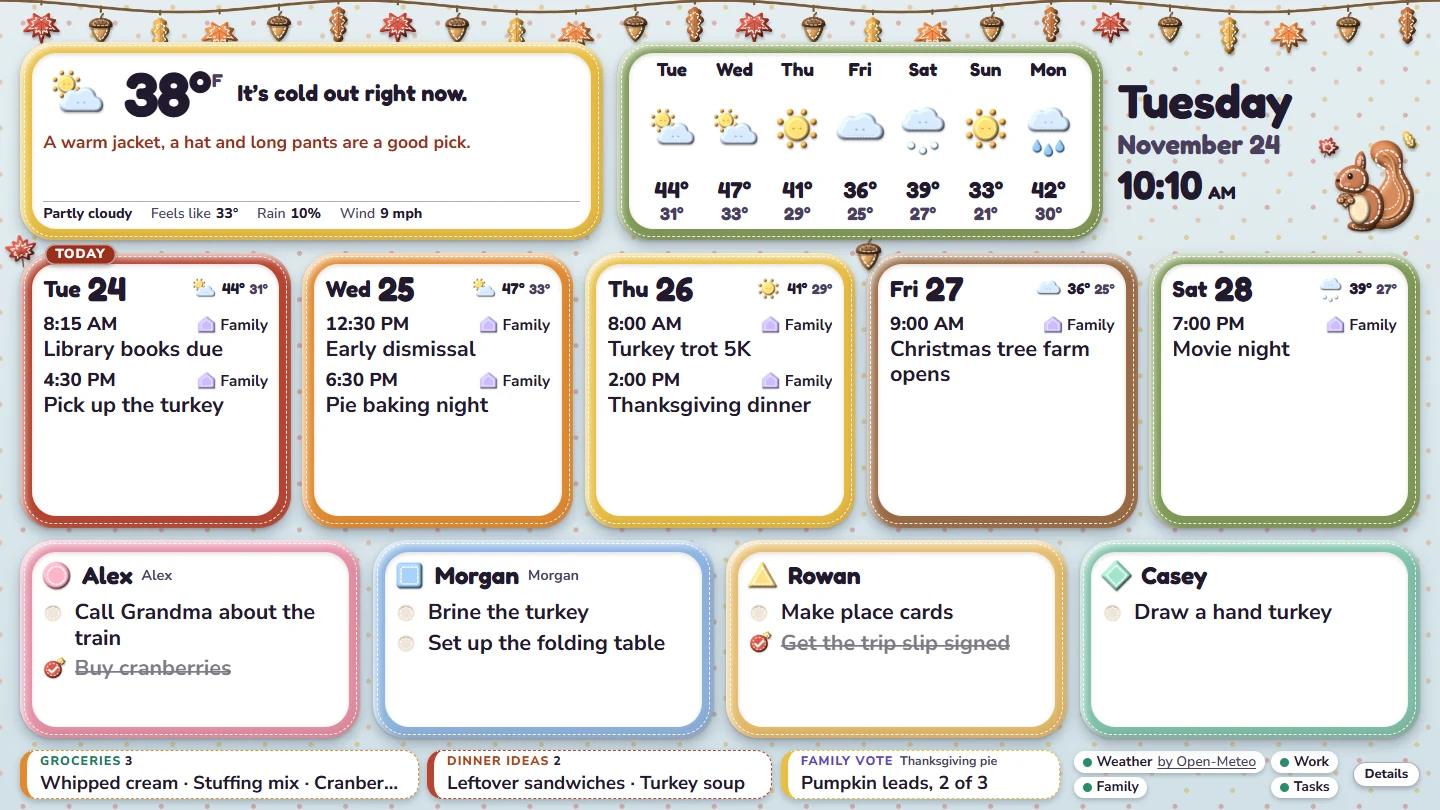
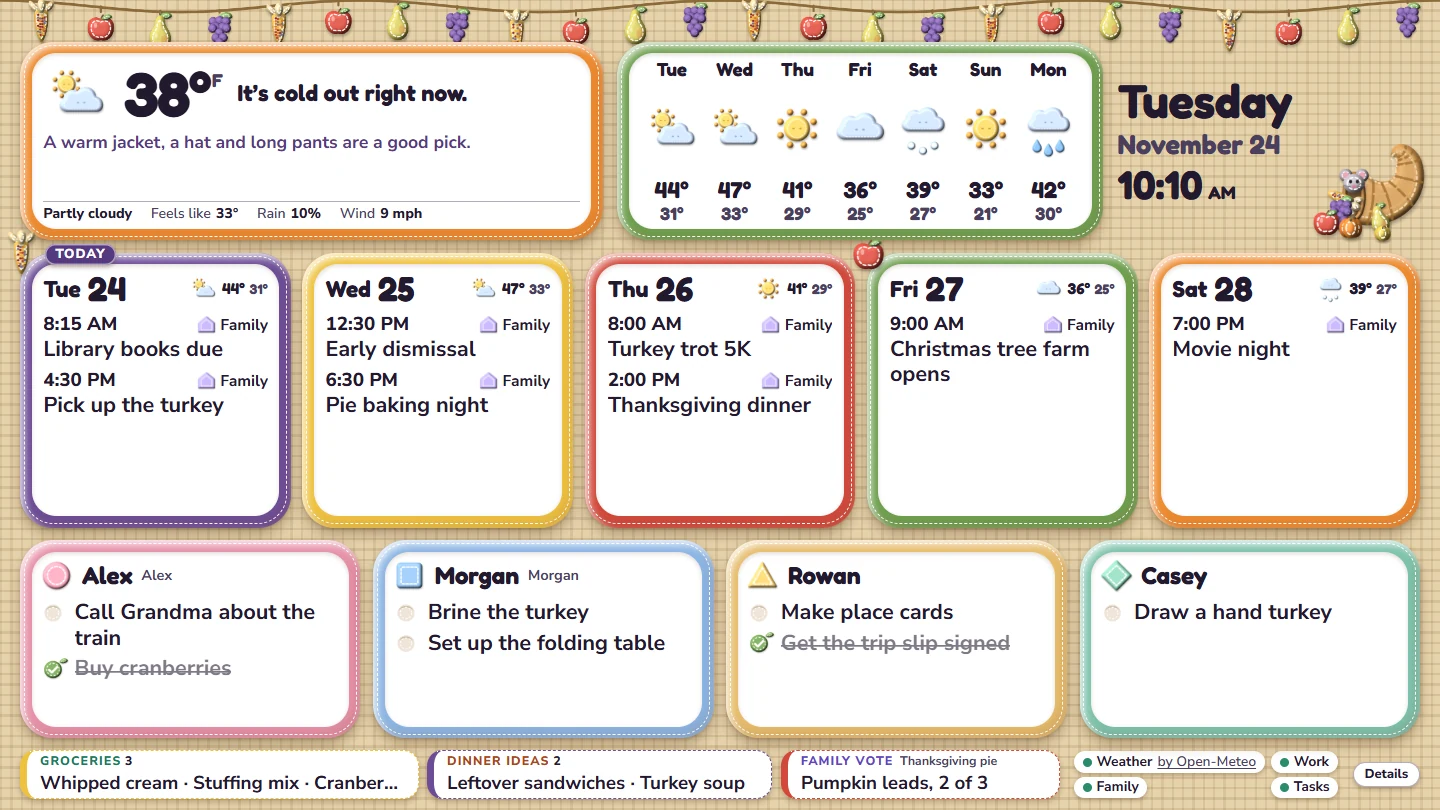
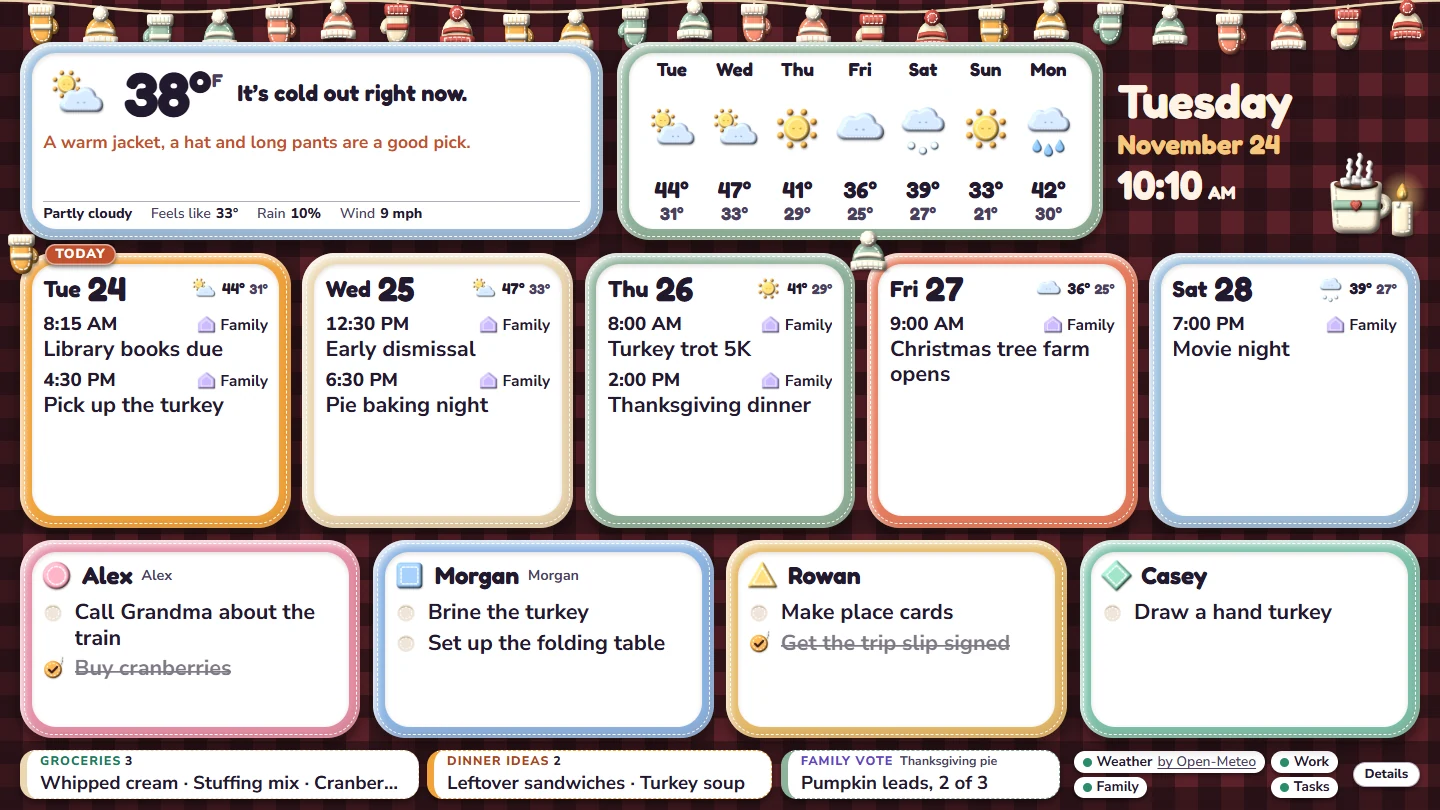
Seasonal does not automatically mean shipped. The artwork also includes seasonal changes, including winter. The verified holiday packs in this record are Halloween and Thanksgiving. A dedicated Christmas pack is not part of the shipped history documented here.
The useful changes were often the small ones.
- The phone and board stop being separate demos.
The household projection reads the same durable state as the companion. Completion and undo can be checked across both interfaces. Failed reads retain the last accepted snapshot and label it stale.
- Pillow Fort wins the family vote.
The soft visual direction becomes a higher-contrast production board. The family chooses an actual everyday interface after seeing competing complete treatments.
- Lantern Lane goes live. Berry gets room on the board.
Grocery requests, dinner ideas and a demo vote get a family line instead of being squeezed into a sixth calendar row. Source and forecast indicators make the inputs easier to understand.
- Sunrise and sunset replace an arbitrary clock boundary.
Motion becomes a deliberate preference. Reactions follow real state changes instead of replaying because the board polled the same information again.
- The scene gets richer without losing the words.
The Halloween pack arrives, Lantern Lane gains its anchored street and weather outfits, and long to-do lists turn whole pages every eight seconds. Calendar overflow still uses a visible “+ more” indicator.
- Six clothing items stop looking like an emergency.
An old symbol cap caused an ordinary larger outfit to fall back to a grown-up warning. The corrected layout wraps longer outfits; weather hazards determine the warning. Layouts up to ten items were tested.
- The Thanksgiving pack reaches the appliance.
The release updates the board presentation while preserving household information, calendar configuration and Berry’s runtime.
The Pixel gets the strawberry.
Berry handles the interaction.
BuryBoard displays what changes.
Berry started as a way to let children make requests and interact with shared lists without using the adult controls. It grew into a voice-and-picture interface, then an explorable learning library. Its character states, read-back, explicit confirmation, reviewed content and recovery behavior deserve their own build record.
The interesting boundary is authority. A cheerful strawberry can propose a change. Saving it still needs a clear confirmation. A learning passage can explain something. It does not get permission to edit the household.
- Ask BerryTap and make a short request on the Pixel.
- Read it backSee and hear the proposed change.
- ConfirmSave the agreed change to shared state.
- See it hereThe board reads the updated household view.
A release is more than a screenshot.
Checked in software and on the appliance
The Thanksgiving release passed the build, 13 holiday/time/motion unit checks, 29 Edge checks, 29 Firefox checks and 11 Halloween regression checks. The production artwork was compared byte for byte against the approved kit. The services and data freshness were checked after activation.
Browser fixtures use synthetic busy and ordinary days. They exercise different screen widths, list lengths, date boundaries, image decoding, reduced motion and artwork overlapping text. Household and calendar hashes are checked around a presentation release so a theme update cannot quietly become a data replacement.
Still a real screen in a real room
Short Thanksgiving Full-motion samples on the mini PC ran at roughly 59–60 frames per second. That is a short controlled observation. It does not establish months of thermal stability or readability under room glare.
The richer Lantern Lane street also showed a measurable Full-motion cost in testing. Subtle stayed close to 60 frames per second; Full fell to about 53 in the recorded busy/rain sample. The selected setting remained a household choice.
That is the part of the story I want visible: what the checks established, what they did not, and what changed because we looked.
About the pictures. These are captures of original design previews, with fictional names and demonstration content. They document visual direction, not the current household calendar. The public pages contain no live feeds, family photographs, private service links or household controls.
Record assembled from the original design exploration, the approved art kits, implementation source and dated deployment notes through October 20, 2026. Built by Mark Salisbury with AI collaborators, including Codex and Claude; publication research, integration and verification directed in Codex.